How Big Things Get Done, by Dan Gardner and Bent Flyvbjerg
Ever since I finished How Big Things Get Done by Dan Gardner and Bent Flyvbjerg, I’ve become that slightly exhausting friend who accidentally turns a casual chat about a holiday into a full-blown logistical seminar. Someone mentions a potential trip or a new project, and before I can stop myself, I’m leaning in with, ‘Right, but what’s the actual success rate for a project of this scale?’, at which point I receive that specific, weary look that says, ‘Oh dear, here he goes again with the spreadsheets.’
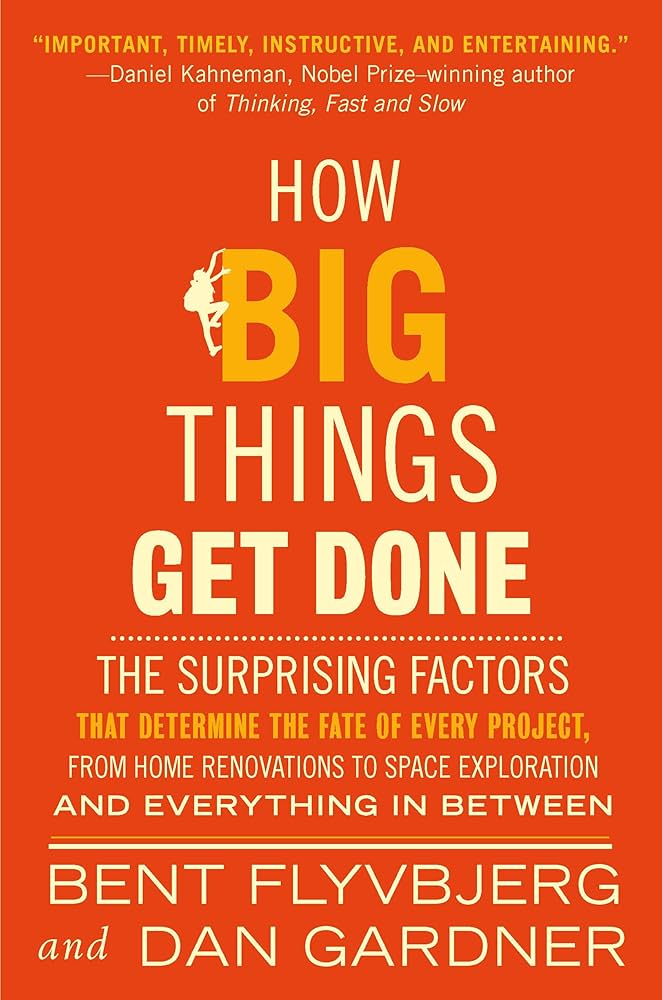
The big takeaway that’s currently stuck in my head is the phrase ‘think slow, act fast’, which sounds simple enough on the surface, but it actually goes against our natural urge to just ‘get on with it’. We often feel like starting immediately is the only way to show we’re serious, and we tend to view any kind of hesitation as a lack of ambition, even though the authors argue that this early rush to be ‘productive’ is exactly where the wheels start to come off. We’re naturally inclined towards optimism. We convince ourselves that our specific idea is special and that we’ll somehow avoid the usual pitfalls, ignoring the fact that our brains are basically wired to underestimate the budget, ignore the clock, and tell ourselves lovely stories about how ‘this time, things will be different’.
Instead of just hoping for the best, the book suggests a very grounded reality check: stop staring at your own ‘perfect’ plan and start looking at the cold, hard data of similar projects—specifically the ones that went pear-shaped. It’s called reference class forecasting, and while it might feel a bit uninspiring at first, it’s actually about refusing to be surprised by the same problems that have been tripping people up for decades.
The book is also quite sceptical of ‘winging it’ on the fly, because while being spontaneous feels quite clever and adaptive, it usually just invites a lot of unnecessary chaos as things scale up. Improvisation just defers pain.
Another bit of wisdom is that the more ‘one-of-a-kind’ or overly complex you make a project, the more opportunities you’ve created for it to break, whereas the slightly more ‘boring’ approach—using standard designs and things that have worked a thousand times before—keeps everything steady. In fact, the more moving parts a project has, the more you need to lean into meticulous, to-the-minute planning to keep the whole thing from collapsing under its own weight.
The most convincing part, though, is how all this extra thinking actually makes you faster in the end. Since reading it, I’ve made it a point to allocate 90% of my total projects’ timelines to planning and only 10% to the actual execution. Spending more time pondering at the start isn’t a waste of energy; it’s a way to ensure the execution phase is as short and focused as possible, because risk lives in time. The longer a project drags on, the more chances the world has to throw a spanner in the works, so by being incredibly thorough at the beginning, you’re simply shrinking the window where things have the opportunity to explode. Be like a tiger: linger long, then snatch the prey in a flash.
Ultimately, the book moves away from the idea of the ‘heroic leader’ who saves the day at the last minute, pointing out that the most successful projects aren’t rescued by flashes of brilliance, but by honest feedback and simple systems that catch problems while they’re still small and manageable.
I ended up really liking the book for how calm and sensible it is. It makes a brilliant case for being the person who slows things down at the start, asks the slightly awkward questions, and remains wary of too much early excitement. As it turns out, overthinking isn’t the enemy. It’s far better to fail a hundred times on the drafting board, where it’s free to make mistakes and fix the errors, than to fail once during deployment when the stakes are real.