Initiation à la mathématique d’aujourd’hui, by Irving Adler
(So, when I write book reviews I normally don’t go over the entire book section by section or provide a summary. I prefer to write about the main impressions I got from it. If you’re interested in a full review of this book, maybe because you’re deciding if you should buy it or not, this post can help, but perhaps not as much as a normal reader’s review of the kind you find in specialised websites.)
Here’s the cover of this amazing book:
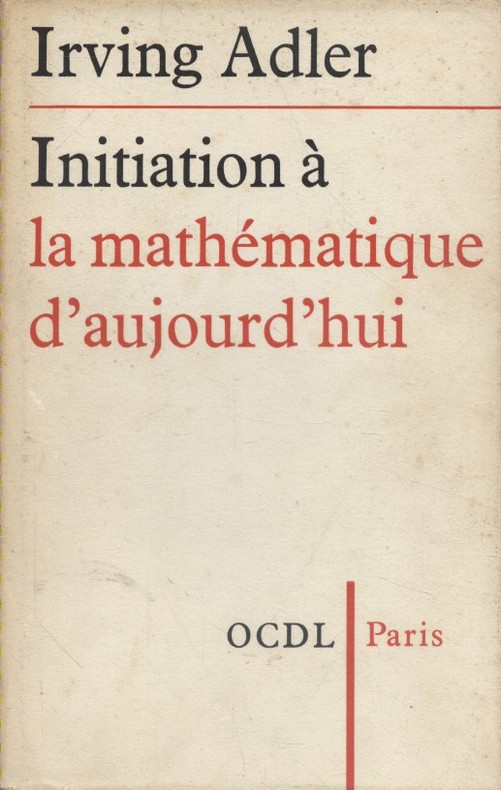
It’s in French, mind you. The book was originally written in English, though (‘The New Mathematics’). Anyway, I bought this French copy in a thrift store (for less than a pound!) and quickly fell in love with it. I was about 18 at the time and wanted to learn both maths and French, so this book was like killing two birds with one stone.
What really opened my mind was the section where Adler explains that you can multiply the rotations of triangles. I’d thought, like most people, that you could only multiply numbers. But, turns out, you can multiply a whole lot of stuff. Later in the book, I learnt that what mathematicians call ‘numbers’ don’t have to be the normal ‘numbers’ we encounter in daily life, but really whatever thing you can make to behave in the way those normal numbers do. Adler takes you step by step from the natural numbers to the real numbers, to the complex numbers, and shows you that what makes them numbers is simply that they follow the rules that mathematicians have agreed ‘numbers’ should follow.
I mention the rotations of triangles because, oddly, that was something I’d been struggling a lot with in those days. I worked at an office where we had to print out lots of documents every day, and I never really figured out how to properly place the paper to prevent the printer from printing upside-down or on the already-printed face. This book showed me that you can design a little multiplication table to help you sort out all the ways you can permutate the corners of a piece of paper in space. I never create the table tho, so my manager finally opted for assigning the printer to one of my colleagues.
Another thing I like about this book is how easy it is to follow. I would read it while commuting to work, so I wasn’t able to dedicate too much mental focus to it. It is a book about pure maths, so you don’t get lots of real-world application examples. And I read it in a foreign language. And still, I was able to understand most of it. So, yes, this is a great book if you’re the kind of person who doesn’t want to get bogged down in a ton of super technical stuff.
For me, the main takeaway was that maths aren’t part of the real world, but simply a model we’ve created of it, like a videogame emulator. I learnt that you can alter the rules of maths (the axioms) to create new models that don’t reflect the real world, if you like. Maths became this sort of very sophisticated language game instead of a thing that was immutable and grounded in external reality (I’ve written about that here). That, instead of discouraging me, freed me to think about many things in the world mathematically, ie, to create mathematical representations of bits of the world that people think can’t be quantified, and then play with those models to see where they can get us.
That little fantasy died a little when I discovered chaos and complexity. But I still think that there’s a case to be made for creating tailor-made discrete mathematics for specific human problems, including in psychology and the social sciences.
So there you have it. This is the book that broke the spell and showed me that maths can be invented, reshaped, annulled, reformulated. That they are a conlang, so to speak.